Northline Awards · buyer guide
Executive desk nameplates: fixed engraving or changeable inserts
For a worldwide Northline Awards desk-nameplate order, choose fixed personalization when the object belongs to one person and a changeable insert when the displayed identity must change within a retained holder. Compare the complete nameplate, including its footprint, viewing sides and access method. A reusable-looking frame does not establish that its insert is replaceable.
Reviewed 2026-09-05 · AI-assisted editorial review. General buying guidance; illustrative scenarios are not customer case studies. Images are AI-generated concepts.
Should the nameplate follow the person or the workstation?
Decide who owns the nameplate when the employee changes desks or roles. A personal executive gift can move with its recipient, while a workstation identifier may stay with the desk and receive new text. That distinction determines whether replacement access is a daily operational need or an occasional future possibility.
Ask the office owner which information changes independently. A person’s name may remain stable while their role or department changes. If both are engraved into one permanent face, that update concerns the whole inscription. A design with separately changeable information may support another workflow, but only if its construction and intended use are confirmed in the proposal.

What makes an insert genuinely changeable?
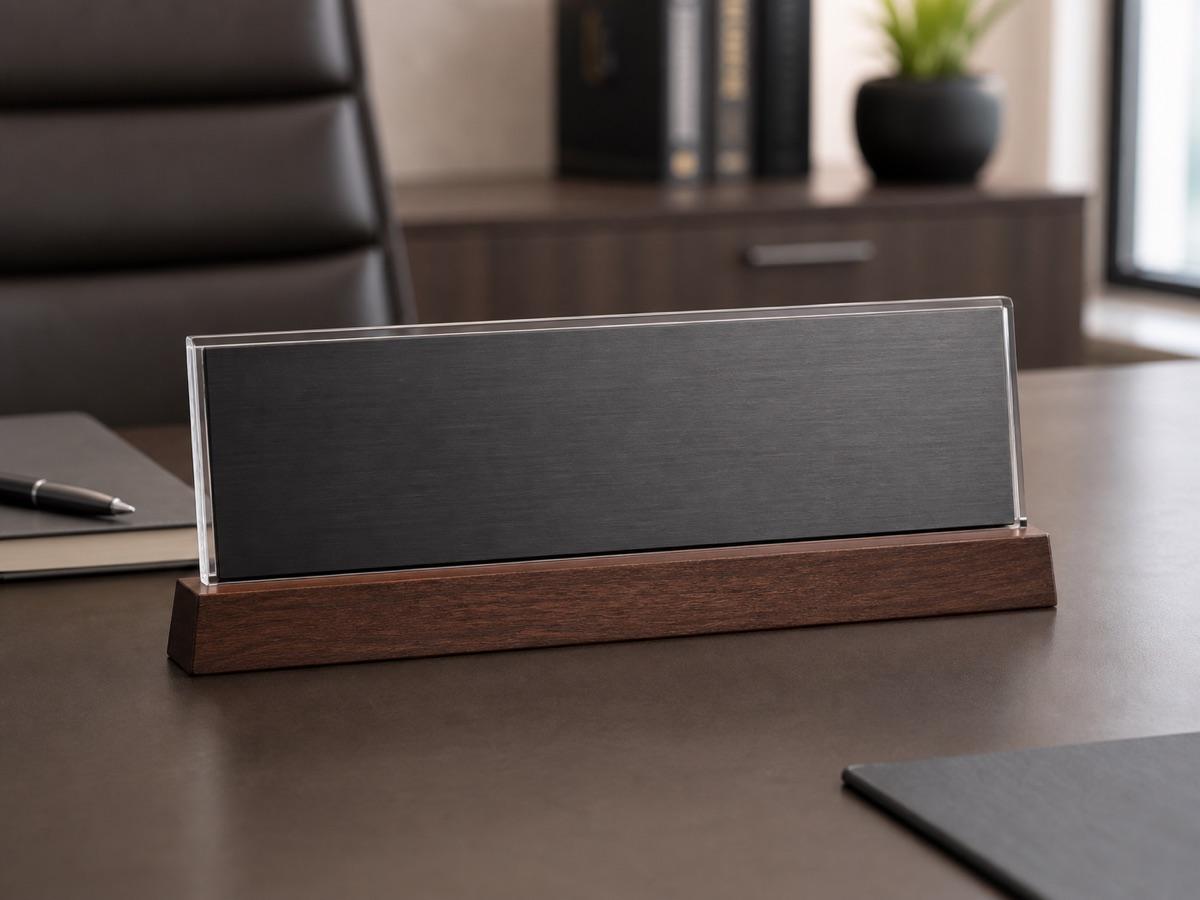
A changeable insert needs a defined access method, compatible replacement format and clear instructions for the person performing the change. Ask which components are removed, which remain and whether any accessory is required. A visible seam or front cover alone does not prove that routine replacement is supported without damaging the assembly.
Request a demonstration or a written explanation for the proposed holder rather than assuming another seller’s mechanism applies. Confirm whether the purchase includes the first personalized insert, a blank insert or only the frame. If office staff will create future inserts themselves, specify the accepted material and dimensions instead of treating ordinary paper as universally compatible.
Office Sign Company describes desk-sign frames with a removable clear lens and replaceable inserts.
Sources: Office Sign Company: Premium reception desk signs with inserts
Which dimensions matter beyond the printed name area?
Record the available desk footprint separately from the visible inscription area and the insert’s physical dimensions. A frame may occupy more space than the name window, and an angled stand can extend behind it. The buyer needs the complete envelope to assess placement beside a monitor, document tray or reception equipment.
Keep width, depth and height labeled with units. A nominal product size might describe only one component. Ask for a drawing that identifies the assembled footprint and any clearance needed to remove the insert. A holder that fits on the desk can still be awkward to update if it must be lifted around cables or neighboring objects.

Does the desk nameplate need one readable side or two?
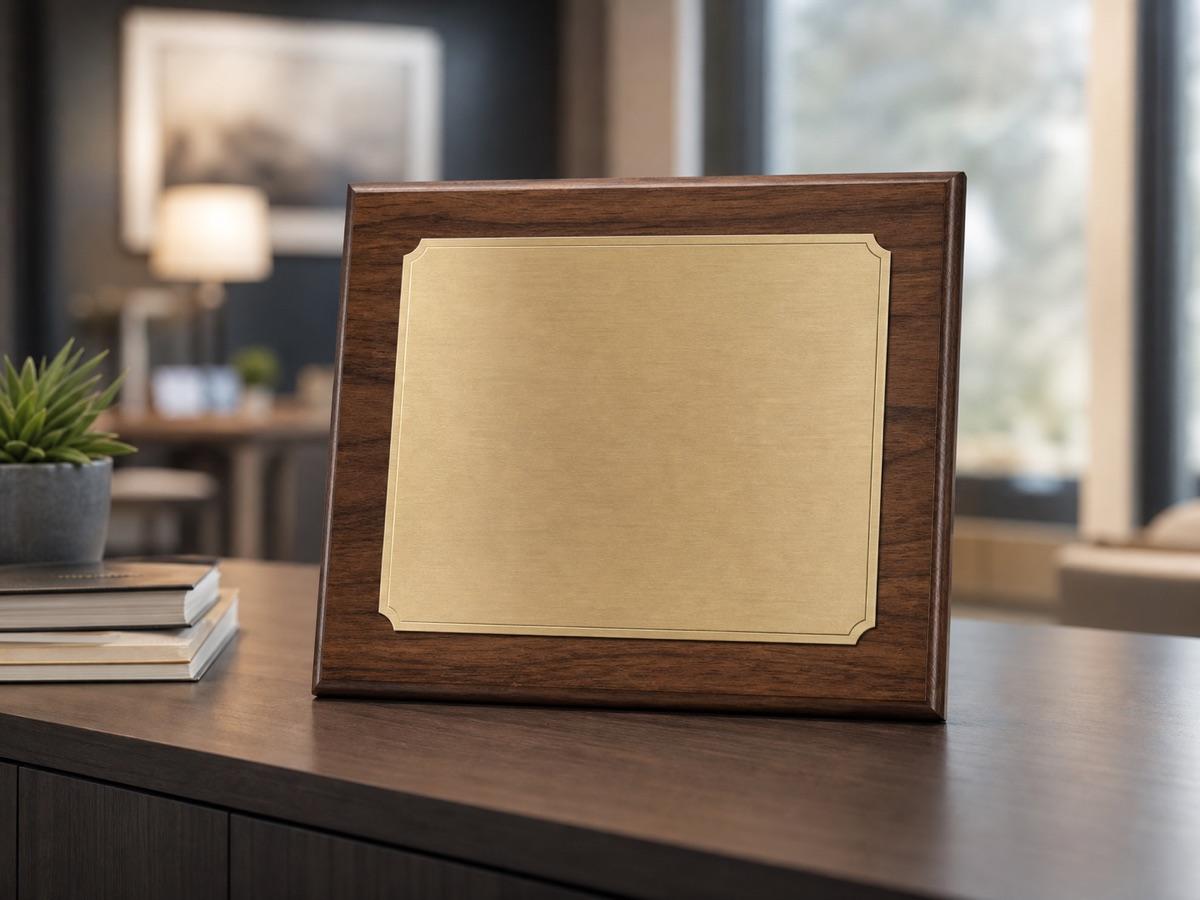
Choose the viewing arrangement from how people approach the desk. A visitor-facing plate may need one main reading side, while a shared table or open workstation may benefit from information visible from two directions. Ask whether a second side is included, separately personalized or simply the unfinished back of the first design.
For a two-sided proposal, review both views in their intended orientation. Reversing a clear component can change how text appears, and a decorative back does not necessarily provide another reading face. Avoid assuming a double-sided layout from a photograph that shows reflections. The approved drawing should make the front, back and reading direction explicit.
How should material and background support the name?
Choose a background and text treatment that make the approved name readable in the intended desk setting. Clear acrylic, a metal face and a wood-backed plate can create different visual relationships with objects behind them. Review the actual proposed lettering against a representative background before selecting a material solely for its catalog appearance.
Keep material identity separate from finish descriptions such as brushed, clear or wood-look. Ask the quote to name the substrate and personalization treatment for each visible component. A finish can affect the design without establishing the underlying material. If the nameplate is also a personal gift, let the recipient’s intended display preference inform the comparison.
Use the article’s example files
The worksheet contains fictional selection scenarios and unresolved specification fields. Replace them with the actual product proposal; sample dimensions and quantities are not catalog specifications or production approval.
Should a logo share the same insert as the employee name?
Place the logo on the changeable insert when it should be replaced with the personal information, or on a retained component when the office deliberately wants it to remain. The artwork allocation affects future updates. A role change should not require discarding an otherwise useful branded holder unless that is the selected construction.
Review the actual logo and the longest approved name together. A large fixed emblem can consume the area needed for a longer successor’s name. Ask which elements can be resized or rearranged during an update and which are physically permanent. Save the accepted layout boundaries so future insert work has a clear starting point without copying outdated personal text.
How do you compare the first purchase with future changes?
Compare the complete initial nameplate and the separately quoted replacement work that the office expects to need. Fixed engraving may suit a long-term personal object, while a changeable system creates a retained holder and future insert task. Neither arrangement has a proven lower lifetime cost until the actual quantities and quoted work are known.
Use symbolic fields while prices are pending: initial holder or complete piece, first inscription and any later replacement insert. Do not multiply an assumed change rate into a savings claim. The office can document its own expected use without presenting that expectation as measured turnover. Ask whether future inserts require a minimum batch or new artwork review when relevant.
What should the sample or first proof establish?
Use the sample to answer a defined question: complete desk fit, name readability, two-sided orientation or insert access. A visual approval of the front face does not establish that a staff member can change the insert as intended. Record which questions were tested and which still require supplier confirmation before ordering the group.
For an updateable system, test a replacement scenario using approved sample text. Confirm that the new insert is identifiable and that the retained frame remains complete afterward. For a fixed gift, focus on the assembled appearance and stable identity. The test should reflect the intended buyer task rather than merely show that the logo looks attractive on a screen.
Which details should the accepted nameplate specification retain?
Retain the complete product reference, assembled dimensions, insert specification, artwork allocation, viewing sides and agreed replacement method. These details explain what the buyer accepted when the holder is reused or the gift is reordered. A photograph and an employee name are insufficient to distinguish a fixed engraved face from a modular insert system.
Include care information appropriate to the selected construction and identify who keeps replacement accessories if any are supplied. At receiving, confirm that the ordered first inserts and holders are both present. Give Northline Awards the approved use, text and complete scope so the final proposal can distinguish personal desk gifts from office assets that change hands.
Illustrative example: how do two nameplate designs support a role change?
A fictional office compares a fixed personal nameplate with a retained holder and replaceable insert for the same desk. Both begin with Avery Chen and Client Services. The office later wants the role line to read Regional Director while keeping the person’s name. The comparison concerns the changed component, not an assumed price.
In the fixed design, the buyer asks for the actual correction or replacement proposal for the personalized face. In the modular proposal, the buyer asks for one compatible new insert and confirms that the retained holder remains usable. Neither route is approved by appearance alone. The worksheet leaves material, access method and replacement cost awaiting the supplier’s written specification.
A second scenario transfers the workstation to another employee. A personally owned engraved gift can leave with Avery, while an office-owned holder can stay if that was the agreed ownership rule. The correct selection therefore follows the object’s job. It does not follow a blanket claim that interchangeable nameplates are always cheaper or fixed engraving is always more meaningful.
Which desk-nameplate construction fits the update pattern?
Compare a fixed personalized object, a retained holder with replaceable insert and a shared desk identifier by what changes and who keeps the item. These are different operating arrangements even when their front views look similar. Confirm the complete included scope and access method before using appearance or unit price to decide.
| Option | Useful when | Specification to confirm |
|---|---|---|
| Fixed personal nameplate | The object belongs to one named recipient | Complete face, footprint and later correction options |
| Holder with replaceable insert | The desk identity changes within a retained frame | Insert format, access method and first-insert inclusion |
| Shared desk identifier | The workstation needs a stable role or function label | Approved shared wording and viewing directions |
What should buyers confirm before ordering?
Desk-nameplate buying questions become clearer once ownership and update needs are defined. These answers address quote scope, replaceable parts, viewing sides and future role changes. Ask Northline Awards to describe the actual assembly and first personalization rather than infer what is included from a front-facing product concept or nominal name-window size.
What should a fixed-versus-changeable nameplate quote include?
Ask Northline Awards to identify the complete nameplate or holder, first personalized face, material, viewing sides, accessories and delivery. Request any relevant replacement-insert scope separately. A frame-only price is not comparable with a finished engraved gift, and an unpriced future update should not be treated as a guaranteed saving.
Can any nameplate with a clear cover accept new inserts?
No. Confirm the actual access method and compatible replacement format for the proposed assembly. A cover may be decorative, protective or permanently attached. Ask who can perform the update, whether an accessory is required and what first insert is included before choosing the product for a shared or changing workstation.
Should an executive gift use an interchangeable insert?
Choose according to the intended ownership and display use. A personal gift can reasonably have fixed text when the recipient will retain it, while a nameplate that stays with an office may benefit from confirmed update access. Do not assume that an operationally reusable design is automatically the preferred personal keepsake.
Does double-sided mean the same text appears correctly on both faces?
Ask for both reading views in the proof and confirm what is personalized on each side. A transparent back or reflected front is not necessarily another readable face. The complete specification should identify the front, back and intended viewing directions so the delivered nameplate matches how visitors approach the desk.
What happens when the employee’s title changes?
Refer to the accepted construction. A fixed personalized face needs an actual correction or replacement assessment; a modular holder needs a confirmed compatible insert. Keep the employee name, new role and retained components explicit, and review the revised complete layout rather than assuming the old title can simply be removed.
Sources and scope
The sources below support the cited technical details. The ordering workflows are editorial recommendations. Your project specification, price and schedule are established in the written quote and approved proof.
- Office Sign Company: Premium reception desk signs with inserts · checked 2026-09-05
Which buying guide should you read next?
All buying guidesKeep the approved design files, physical specifications and personalization rules together so next year’s order can repeat the intended design with a new roster.
Provide the required arrival date, quantity, destination, selected design, artwork status and final personalization list. Name one proof approver. Preparation can begin with a complete brief, but dimensions, materials and approved wording must be settled before the production steps that depend on them.